
Friday, November 17, 2006
Happy people are less sick than the Grousers


 Dr Cohen and his friends of the Carnegie Mellon University of Pittsburgh (PA) gathered 334 healthy volunteers aged 18 to 54 years. They categorized them in 2 sets : the "positive" on one side (happy, glad, dynamic and sociables) and the "negative" on the other side (dissatisfied, stressed and especially grousers). Then, they gave them nasal drops containing a rhinovirus. During 6 days, researchers collected data on the health of the patients. Objective data like the production of mucus but also of subjective data like the complaints of pains, cough, etc.
Results: The tendency to experience positive emotions was associated with greater resistance to objectively verifiable colds. In other words, the group "positives" fight the virus better than the group "negative". Moreover, but that's more obvious, the "negatives" complained more easily about symptoms than the "positives", at "equal disease".
The researchers show that the joy, not the self-esti or the optimism, can explain these effects. They speak about objective reasons like the fact that the joy boosts the immune system, and subjective reasons like the fact that happy people are less worried about a cough or a noise which falls.
Today, looking at grousers, just think that they maybe won't survive this winter ... and smile :)
Source: Le journal santé, today, corrected by Psychosomatic Medicine in july 2002 !
For those who do not know:
-A rhinovirus is a genus of the Picornaviridae (!!) family of viruses. Rhinoviruses are the most common viral infective agents in humans, and a causative agent of the common cold. There are over 105 serologic virus types that cause cold symptoms, and rhinoviruses are responsible for approximately 50% of all cases.
Labels: discoveries


Wednesday, October 04, 2006
Lasers in Chips
discoveries A team of researchers from Intel and the University of California announced last week that they have developed a silicon-based chip capable of producing laser beams!
Great, you say. So what, it's StarWars in my PC?
Allez.
By using light instead of wires to send data between chips or to the memory, we solve the principal bottleneck in computers.
Even if it is announced now, there will be no commercial application before 2010. But the door is opened to many things: routers and switchs mega-high-speed, very quick and very cheap processors, ... That would definitively kill the Moore's Law (which is already almost dead).
Lasers already relay heavy volumes of data over long distances, on optic cables. In computer chips, data passes through the wires at great speeds, but slows to a crawl when moving from one chip to another inside a computer.
With laser beams, we speak about unprecedented speeds.
"This is a field that has just begun exploding in the past 18 months," said Eli Yablonovitch, a physicist at the University of California.
Source: The New-York Times, two weeks ago.
Labels: discoveries
Saturday, September 23, 2006
Fight against Spam: New idea
discoveries
Researchers from the Georgia Institute of Technology have discovered that addressing spam at the network level could be a more effective solution for Internet service providers than today's message content filters.
They've also developed algorithms that can detect when a computer is a member of a botnet, and also a technique for enforcing the security.
"Content filters are fighting a losing battle because it's easier for spammers to simply change their content than for us to build spam filters", explains Nick Feamster, an assistant professor in the Georgia Tech College. "We need another set of properties, not based on content. So what about network-level properties? It's harder for spammers to change network-level properties."
The research has been introduced a few days ago at the ACM SIGCOMM conference, in Pisa in Italy. The researchers spent one year and half collecting Internet routing and spam data from only one domain. They found that they can identify which Internet service providers are transmitting spam, as well as the narrow ranges of IP address that are only producing spam.
Spammers exploit vulnerabilities in Internet routing protocols, succeeding to assign their machines any IP address within that range. They then send spam from those machines and promptly withdraw the route. The IP address is no longer reachable, so the receiver cannot identify it.
Feamster hopes that his research will allow to make those protocols more secured and to improve the spam filtering.
Source: Georgia Research Tech News, two weeks ago.
For those who do not know:
Botnet is a jargon term for a collection of software robots, or bots, which run autonomously. This can also refer to the network of computers using distributed computing software. The word is generally used to refer to a collection of compromised machines running programs, usually referred to as worms, Trojan horses, or backdoors, under a common command and control infrastructure.
Labels: discoveries
Friday, September 22, 2006
The Beer Project
discoveries Researchers at the Australian research agency CSIRO decided to spend the next 4 years developing software tools that will allow animators to create more realistic movement of water for movies and video games.
Something quite complicated for the moment, since you have to know exactly the movement of the liquid, the behaviour of foam, bubbles, splashes, waves, eddies, and whirlpools.
Foam and bubbles? Yes, we told you that those researchers were australian. Belgian researchers would do the same: first, they will simulate the pouring of beer in a glass.
They hope finishing this before the end of this year.
Before that, they simulated the sinking of the Titanic as an example of animated motion of water: complicated mathematical algorithms to calculate the behavior of flowing water, which was then rendered in software for simulating the motion of different objects.
Resolution is a big concern because if it's too poor, the animated fluid would resemble flowing ice. The researchers solved this problem by using Computational Fluid Dynamics, which gave animators control of every particle in the fluid.
Here is a video about that.
Source: The Age, two weeks ago.
For those who do not know: The Titanic is a too long movie of James Cameron.
Labels: discoveries
Thursday, September 21, 2006
DVD, Blu-ray and HD-DVD on one disk
discoveries In a bid to end the long high-definition DVD format war, three engineers from Warner Bros. have invented a disk that can play all three : the "Multilayer Dual Optical Disk" has one layer of data in the standard CD or DVD format, a second layer able to play Blu-Ray and another one for HD-DVD.
The patent was filed by Wayne Smith, Alan Bell and Lewis Ostrover. It works by storing the information at different depths depending on the technology. Blu-ray discs store information only 0.1 millimetre from the surface while HD-DVD discs store it at 0.6 millimetres.
Concretely, it means that consumers can pick which one they want without worrying about what will survive the second generation DVD war. It also means that the studios do not have to pick one technology and can provide the content in both formats.
Source: Yahoo UK, yesterday.
For those who do not know:
The name Blu-ray disk is derived from the blue-violet laser it uses to read and write to the chalcogenide disc. A Blu-ray Disc can store substantially more data than a DVD, because of the shorter wavelength (405 nm) of the blue-violet laser (DVDs use a 650-nm-wavelength red laser and CDs an infrared 780 nm laser), which allows more information to be stored digitally in the same amount of space. In comparison to HD DVD, which also uses a blue laser, Blu-ray has more information capacity per layer (starting from 25GB with test media currently at 100 gigabytes instead of 15). In August 2006, TDK developed a Blu-ray disk with a 200 gigabytes capacity.
The HD DVD name is derived from its origination as a high-definition extension of the DVD optical disc format. A HD DVD disc can store substantially more data than a standard DVD, because of the shorter wavelength (405 nm) of the blue-violet laser (DVDs use a 650-nm-wavelength red laser and CDs an infrared 780 nm laser), which allows more information to be stored digitally in the same amount of physical space. In comparison to Blu-ray, which also uses a blue laser, HD DVD has less information capacity per layer (15 gigabytes instead of 25), though HD DVD is easier and cheaper to manufacture than a Blu-ray pre-recorded disc due to its sharing the same basic disc structure as a standard DVD: back-to-back bonding of two 120 mm diameter substrates, each 0.6 mm thick. The 30 GB dual-sided HD DVDs have been used on nearly every movie released in this format. On the other hand, Blu-ray has only released movies on 25 GB single layer discs.
Labels: discoveries
Wednesday, September 20, 2006
Animated characters look more realistic in the muscles
discoveries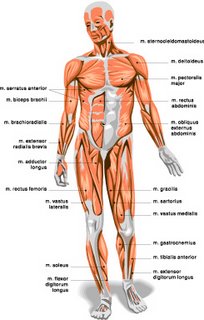 Researchers at the University of Bournemouth in the U.K. have created a set of tools to make the skin and muscles of animated figures move more realistically.
Traditionally, animators start creating characters by drawing their external appearance, adding details such as how muscles look when flexed on the basic design. Animators prefer this skin-based approach because it's the most intuitive and because adding muscle details to a form that you already drawn is quite simple.
But it's less realistic, the character can look "fake" if the skin does not correspond exactly to the muscle behind.
Building the muscles first and then layering the skin on top of them creates more natural-looking characters, though it requires an advanced knowledge of human anatomy (even if the character is not human, our eye is used to that).
Jian Zhang and his colleagues have developed an algorithm that begins a design with the muscles under the skin while the animator focus on the external appearance, while writing the rules on the structure of major muscles.
When a body part is flexed, the animation algorithm makes the muscle expand or contract and the skin react accurately using information about the muscle's shape underneath the skin.
Zhang began by looking at the muscle groups that most often cause skin to move, including the shoulder, neck, arms, thighs, and calves. Then he analyzed the muscles' shapes and simplified them into ellipses. This simplification enable the animators to make realistic movements without having a deep knowledge of anatomy, as well as conserving the computational power required by the process.
 In the figure on the right, the major muscles on the left half of its body have been extracted using the researchers’ technique. The muscles are used to deform the skin surface when the character is animated.
For those who do not know: 3D computer graphics are works of graphic art that were created with the aid of digital computers and specialized 3D software. In general, the term may also refer to the process of creating such graphics, or the field of study of 3D computer graphic techniques and its related technology.
Labels: discoveries
Wednesday, September 06, 2006
Unusual Behaviour
discoveries Researchers of the NICTA, the National ICT Australia, are developing sophisticated surveillance applications such as an algorithm that monitors inappropriate behavior in public places.
The team that works on this stuff makes me scary, maybe because of the name (SAFE, Smart Applications For Emergencies) or maybe just because of the idea.
The team already proposed a specification for a warning language that can discern and communicate threat levels. The goal of the project is to provide maximum information to decision makers.
"Identifying a particular person is one thing but we are looking at unusual behavior in an open environment," said Chris Scott, the scary boss.
The project uses data from the 6,000 surveillance cameras on the network of Queensland Transport and Queensland Rail, expecting to move away from the dependence on humans looking at monitors.
Source: ComputerWorld, this friday.
Labels: discoveries
Wednesday, August 23, 2006
Grid Computing to Predict Storm Surge
 The SURA, the Southeastern Universities Research Association, recently gained more computing power for a computer grid that will be used for a number of research activities, including storm modeling.
First, what is a Computer Grid ?
Wikipedia says it's an emerging computing model that provides the ability to perform higher throughput computing by taking advantage of many networked computers to model a virtual computer architecture that is able to distribute process execution across a parallel infrastructure. Well, everybody has his own definition. The common idea is the comparison with the distribution of electricity. Indeed, the term Grid computing originated in the early 1990s as a metaphor for making computer power as easy to access as an electric power grid: the same way you plug a device on 110 or 220V, you plug your computer on the grid. Behind, a huge quantity of resources (CPUs and memories). Most of the time, it consists in networked computers, geographically distributed and autonomous. And hop, you have access to a phenomenal computing power and a amazing data storage capacity.
That's what happened to the SURA which have obtained new servers that are expected to double the number of CPUs in the heterogeneous environment on the grid to about 1,800, and increase the computing power to about 10 TFLOPS.
A previous article explained that the most powerful computer right now, Blue Gene, reached 360 teraFLOPS. Just to tell that 10 teraFLOPS, it's not so bad.
SURA has spent the past two and a half years building the grid, and is working to develop forecasting models that will allow scientists to accurately predict a storm surge 3 days before it begins to approach. Currently, scientists are accurate in their forecasts about 24 hours before a storm.
Source: Computerworld, two weeks ago.
For those who do not know:
- A central processing unit (CPU), or sometimes simply processor, is the component in a digital computer that interprets instructions and processes data contained in computer programs.
- for the FLOPS, see this article and try to follow ! ;)
Labels: discoveries
Tuesday, August 15, 2006
Combine pictures to make a 3D-model
discoveries Working with several researchers from the University of Washington, Microsoft's Richard Szeliski has developed a technology that converts digital images into 3D model, allowing the user to move, walk or fly into the scene.
It's called Photosynth, and it has been introduced (also) at the SIGGRAPH conference of Boston. The method consists in compiling unique features from different photographs and cross-referencing them against other images, looking for similarities.
That enables it to isolate a specific 3D position and then calculate the camera's location when the picture would have been taken.
"Basically, it's just a geometry problem. You are simultaneously adjusting the position of the camera and where those little pieces of images are, until everything snaps together"
The system can be used with only 2 pictures, but it's much more interesting when several dozen pictures are combined. Szeliski believes that cities and tourism boards, and even photo-sharing sites will soon use this technology. Flickr, Picasa, Talk a Pic ?
Here, a video is available but disappointing. It becomes an habit for Microsoft...
We take the opportunity to mention a great site. Let's imagine that you want to take a photograph of a building in the center of Beijing. Impossible to shot without a tourist or two, minimum. Shot anyway, without moving. Provide the pictures to Tourist Remover which, as indicated, is able to generate a picture with nobody.
Source: BBC News, two weeks ago.
Labels: discoveries
archives >> April - March - February - January -December - November - October - September - August - July - June - May
Powered by Stuff-a-Blog
une page au hasard


